
Cloudways Email: SMTP Add-on Setup, Sending Errors, and Rackspace·Elastic Email Pricing


I checked Cloudways email setup by connecting Gmail to a Vultr Seoul test server through the SMTP add-on. WordPress contact-form and password-reset emails fail to arrive because receiving servers filter mail sent directly from the server, and they only reach the inbox once an external sending service is connected. I have summarized the setup steps for the free SMTP add-on and the pricing of the Elastic Email, Rackspace and Titan add-ons as shown in the console in October 2026.
1️⃣ Types of Cloudways Email Add-ons
Cloudways does not provide a mail server, so all email goes through an add-on that connects to an external service. There are two kinds of add-on: transactional email and mailboxes. Mail that the site sends, such as order confirmations and password resets, is handled by Elastic Email or the SMTP add-on, while mail sent and received at a you@yourdomain address is handled by a Rackspace mailbox.
For transactional email, a server can use only one of Elastic Email or SMTP, and mailbox add-ons are added per domain rather than per server. Mail sent directly by PHP from a cloud server is often classified as spam by the receiving server, which is why Cloudways itself recommends connecting an external sending service.
2️⃣ SMTP Add-on Setup [Gmail]
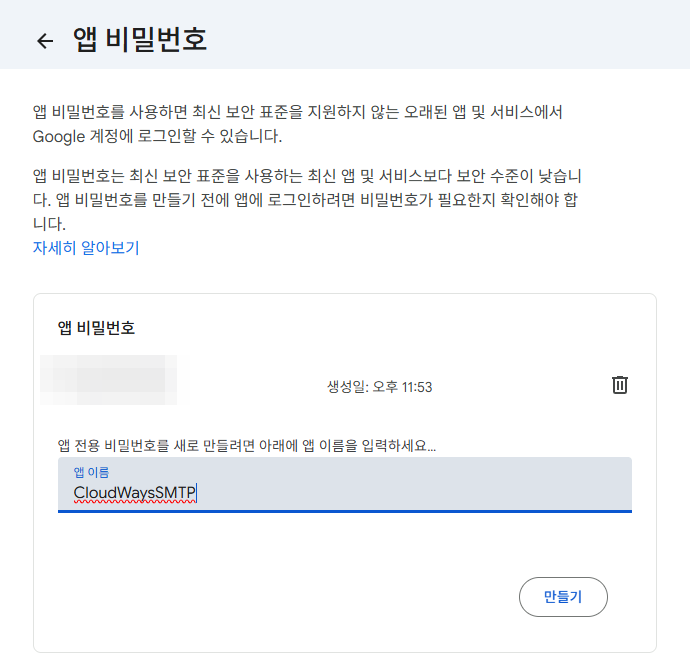
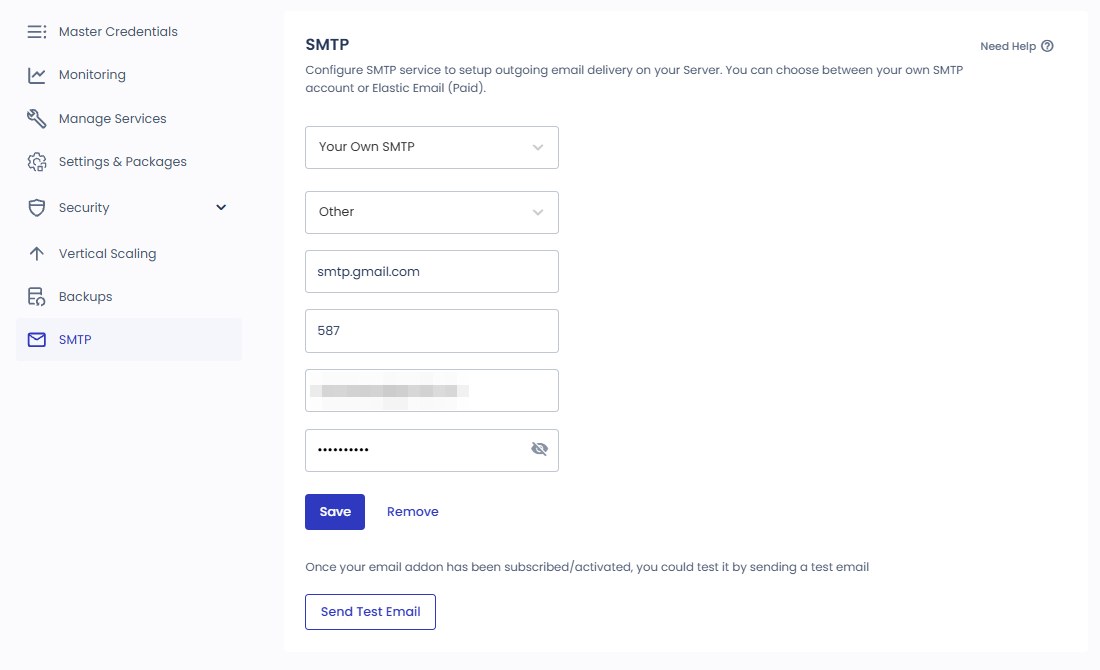
The SMTP add-on is configured in the [SMTP] menu of the server management screen; there is no subscription or fee, you only enter the account details of an external sending service. The connection takes the five steps below, and you first need an app password on the Gmail side.
Gmail rejects SMTP logins with the account password, so turn on 2-Step Verification for the Google account and issue a 16-character password on the app passwords page . If 2-Step Verification is off, this page does not open, and the issued password is entered with the spaces removed.


Gmail does, however, rewrite the sender address to the authenticated Gmail account, so this is not suitable for sites that must keep the contact form’s sender on the site domain. In that case you would connect Elastic Email, or SendGrid or Mailgun with domain verification completed.
3️⃣ Elastic Email Add-on: Pricing and Setup
The Elastic Email add-on is Cloudways reselling the Elastic Email delivery service, and the fee is added to your Cloudways invoice. Packages come in 12 tiers by monthly sending volume, and the prices shown in the console on October 9, 2026 are in the table below.
| Monthly volume | Monthly fee | Monthly volume | Monthly fee |
|---|---|---|---|
| 1,000 emails | $0.10 | 25,000 emails | $2.30 |
| 3,000 emails | $0.30 | 50,000 emails | $8.00 |
| 5,000 emails | $0.50 | 100,000 emails | $15 |
| 8,000 emails | $0.80 | 250,000 emails | $25 |
| 12,000 emails | $1.10 | 500,000 emails | $37 |
| 15,000 emails | $1.40 | 1,000,000 emails | $57 |
One package can be attached to several servers, and the sending domain must be verified by adding SPF, DKIM, Tracking, MX and DMARC records to DNS before mail goes out. According to the support docs, you subscribe to a package under [Integrations] › [Add-Ons], then select Elastic Email in the [SMTP] menu of the server management screen to connect it.
4️⃣ Rackspace and Titan Mailbox Pricing
The Rackspace Email add-on is billed per mailbox and prorated by the days used, and webmail, IMAP and domain aliases work the same as with a direct Rackspace contract.
In August 2026, Titan Email was announced as a new mailbox add-on with three plans: Pro, Premium and Ultra. Migrating existing mail is free, and the support docs say that accounts without a Rackspace subscription before the Titan launch get Titan as their mailbox option. That said, the add-on list of the uknew account checked on October 9, 2026 still showed only Rackspace.
| Item | Rackspace | Titan Pro | Titan Premium | Titan Ultra |
|---|---|---|---|---|
| Monthly fee per mailbox | $1.50 | $1.99 | $3.99 | $8.99 |
| Mailbox storage | 25GB (fixed) | 25GB | 50GB | 100GB |
| Migrating existing mail | $10 per migration | Free | Free | Free |
| Mobile apps | None | Yes | Yes | Yes |
| Management screen | Separate console | Cloudways dashboard | Cloudways dashboard | Cloudways dashboard |
The prices in the table are monthly fees per mailbox; Rackspace is as shown in the console on October 9, 2026, and Titan as published on the official Cloudways blog on August 5, 2026.
5️⃣ Troubleshooting WordPress Emails That Do Not Arrive
If the test email returns [Unable to send the email. It seems that the provided SMTP service credentials are incorrect.], Gmail has rejected the login. The most common cause is entering the account password where the app password belongs; in the test, the same error kept repeating until an app password was issued and entered.
The checklist is: confirm that 2-Step Verification is on for the Google account, check whether an entry exists on the app passwords page, and if not, create one and save it again with [Update]. If the app passwords page shows [The setting you are looking for is not available for your account], that account has 2-Step Verification turned off.
🔢 FAQ & Recommended Content


ℹ️ Affiliate Disclosure
This site's content contains affiliate links. When a visitor buys a product or service through one of them, the site receives a commission from the seller. The amount the buyer pays(it goes down during event discounts ↓)does not go up. Posted prices, discounts, and stock reflect the time of writing and may differ, so confirm with the seller before buying. Products are chosen and reviewed by our own standards, and commissions do not affect the order or content of reviews.